What does a person want from life?
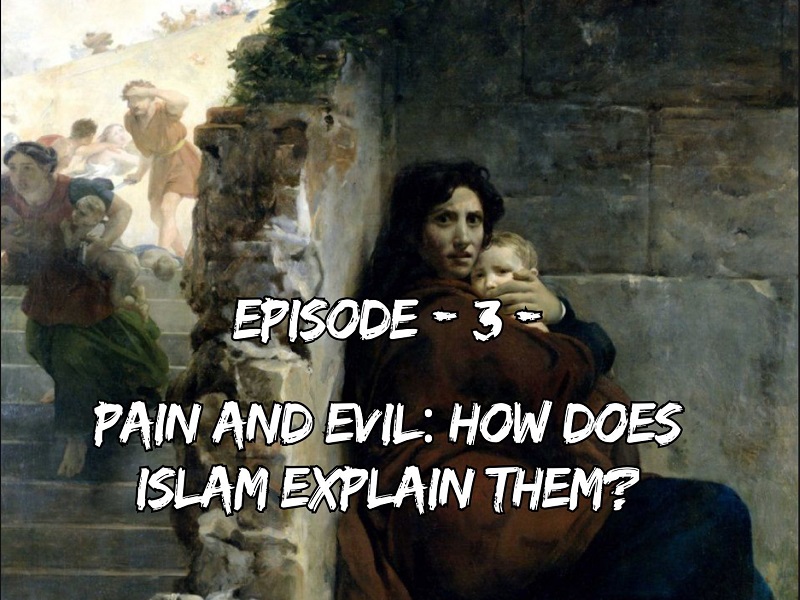
Episode – 3 – Pain and evil: How does Islam explain them?
Almost every person, regardless of their language or culture, has this question: If God is good, why does pain exist? Why does He allow evil? Why do innocent people suffer?
These questions do not stem from rebellion as much as they stem from genuine human pain, and from a desire to understand before accepting.
Islam does not deny the existence of pain, nor does it attempt to embellish it or present it as something illusory. On the contrary, it acknowledges it as a real part of the human experience in this life. However, it rejects the notion that pain is evidence of futility, a sign of the absence of meaning, or a denial of divine mercy.
In the Islamic perspective, life is not paradise, but a journey. It is not an end, but a stage. Hence, the presence of suffering cannot be understood in isolation from the nature of this stage. The world was not created to be free of suffering, but rather to be a testing ground for humanity: in its patience, its choices, and its awareness.
Evil, in Islam, is not an independent entity, but rather, in essence, a product of poor choice. Human beings have been granted free will, and with it comes the possibility of deviation. Without this possibility, choice would have no meaning, and good would have no true moral value.
But Islam does not reduce all suffering to human error. There is suffering that has no apparent cause, and no direct fault behind it. Here, Islam offers a deeper understanding: some suffering is not punishment, but a trial; not to destroy a person, but to awaken them, refine them, or raise them to a level of awareness they could not have reached without this experience.
In this context, pain is not measured by its intensity, but by its effect on the inner self. Pain may be a cause of defeat, or it may be a gateway to maturity. It may be a fall, or it may be the beginning of a new path. The meaning lies not in the pain itself, but in how we deal with it.
In Islam, the understanding of pain is linked to the concept of divine justice. Justice is not fully realized in this life, but is perfected in the hereafter. Without belief in an afterlife, pain becomes unjustifiable, and injustice senseless and inexplicable. In the Islamic worldview, no tear is wasted, no pain is ignored, and no injustice is forgotten, even if the world appears silent.
Therefore, Islam does not view death as the end of tragedy, but rather as the beginning of the revelation of truth. There, rights are restored, experiences are understood, and a person realizes that what they went through was not meaningless, even if they were unable to understand it at the time.
Islam does not promise a world without pain, but it offers a perspective that allows us to understand our pain, a meaning to bear it, and a hope that will not crumble. It does not ask us to love pain, but rather to understand our place in the journey, and to realize that mercy can sometimes be hidden within the most severe trials.
Hence, the next question becomes natural: if life has meaning, and pain has an explanation, what about the end? What about death, and what comes after it? This is what we will approach in the next episode.
What does a person want from life?
Episode – 1 – What is the meaning of life in Islam?
Episode – 2 – Man between freedom and choice in Islam
Episode – 3 – Pain and evil: How does Islam explain them?
Episode – 4 – Death: an end or a transition?
Episode – 5 – The afterlife: justice and ultimate meaning
Series conclusion. How does this understanding change in human life?