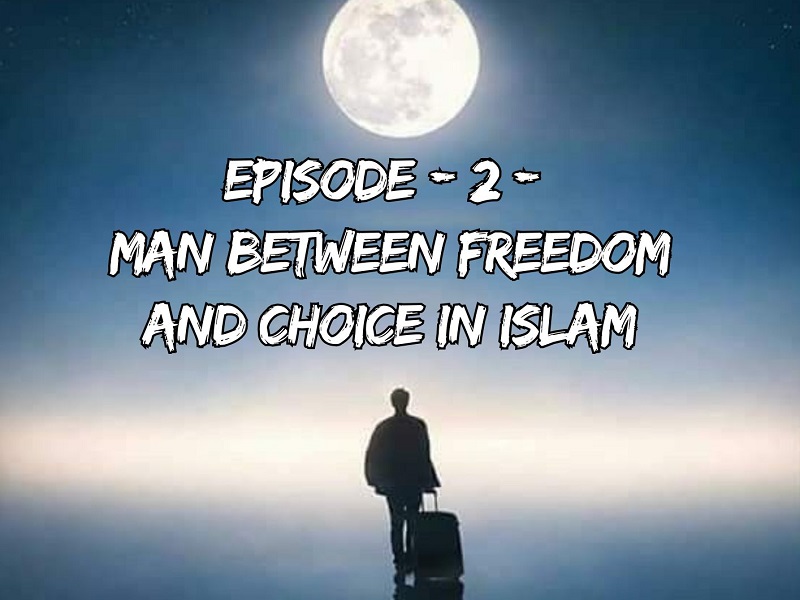
Episode – 2 –
Man between freedom and choice in Islam
One of the most perplexing questions for humankind, both in ancient and modern times, is: Are we truly free? Or are our lives governed by forces against which we have no control? Do we choose our destinies, or are we driven towards them against our will?
In Islam, humankind is not presented as a being entirely predetermined, nor as a being of unlimited freedom. Rather, it is viewed as a human being granted a degree of freedom within the broader framework of divine wisdom. This is true freedom, but it is responsible, not arbitrary.
Islam begins with a clear truth: humankind was created with free will. Choice is not a secondary aspect of life, but rather the very essence of humanity. Without the capacity for choice, good would have no meaning, evil no weight, and accountability no justification. Humans are not held accountable for their existence, but for their choices.
But this freedom is not absolute. There are things a person does not choose: their time, their place, their form, their beginnings, and their inevitable end. These are not constraints that negate freedom, but rather a framework within which one operates. Freedom in Islam does not mean controlling everything, but rather using what is available to you wisely.
Herein lies the difference between freedom and desire. A person might think that the more they indulge their desires, the freer they are, while Islam views them as enslaved, not free. True freedom does not mean doing whatever one pleases, but rather being able to refrain from actions that harm oneself.
Choice in Islam is not a fleeting test, but a way of life. At every moment, a person chooses: how to think, how to act, and how to interact with themselves and others. Even in the harshest of circumstances, the space for choice remains: choosing the stance, not the event; choosing the meaning, not the pain.
Hence comes responsibility. Islam does not separate freedom from accountability. The wider the circle of choice, the wider the circle of responsibility. Therefore, a person is not questioned about what they were not given, nor held accountable for what they did not choose, but rather for what they were capable of.
In this understanding, fate is not the antithesis of freedom, but rather its context. Fate sets the stage, and man chooses his role. Divine justice is manifested in the fact that judgment is based on choice, not circumstances.
In Islam, man is not a victim of blind fate, nor an absolute master of the universe, but a conscious being, accountable and capable of either rising to greatness or falling into ruin, according to his own choices. Thus, freedom becomes a blessing, but at the same time a weighty responsibility.
This understanding of freedom and choice paves the way for the following questions: Why does evil exist? Why does pain exist? Could life have been without suffering? These are the questions we will approach in the next episode.
What does a person want from life?
Episode – 1 – What is the meaning of life in Islam?
Episode – 2 – Man between freedom and choice in Islam
Episode – 3 – Pain and evil: How does Islam explain them?
Episode – 4 – Death: an end or a transition?
Episode – 5 – The afterlife: justice and ultimate meaning
Series conclusion. How does this understanding change in human life?